
We help leadership teams see how their product and technology delivery system really performs, where AI will pay off, and what must change first.
Our services
Strategy, baseline and support. Start with one, combine two, or use all three, depending on where your organisation is today.

Best for:Leadership teams who need to know where AI will change cost, capacity and speed across the whole delivery system.
You get:A prioritised AI strategy, tied to what the business and product organisation are trying to achieve.

Best for:Organisations that need an honest, benchmarked picture of how delivery performs today.
You get:What is working, what is wrong, what is missing, and where AI and other efficiencies will improve delivery.

Best for:Teams with a plan who need senior, hands-on help making AI or a wider transformation stick.
You get:Fractional support alongside your team, for as long as the change needs it.
Most technology companies have adopted AI the same way: AI-coding tools, disconnected pilots and individual heroics. It looks like progress, but it's not adding up to a return anyone can measure. And it creates problems of its own. These are the patterns we see most often.
01
Nobody can say for sure whether AI has materially improved growth, margin, customer outcomes or delivery performance.
02
Individual tools and pilots haven't become repeatable organisational capability. They are heroics rather than habits.
03
Teams need enabling without fear, but speed can't come at the cost of data, IP, security or quality. The business basics still apply.
04
We know faster code generation can simply push the delay into review, testing, pipelines and decision-making.
05
Without a credible baseline of where you are now, there is no way to connect AI spend to measurable outcomes.
06
The CEO, CTO, CPO and engineering leaders don't share the same ambition or priorities, or even agree on what success looks like.
As an organisation you need to better understand and align on where next to invest, how much, and in what order.
Layer AI over a weak delivery system and you get faster problems, not faster value. But delivering value isn't only about technology. The whole organisation influences whether value lands. That's why you need a 360 view of delivery: how the whole system works together to create, deliver and realise value.
How well the organisation decides what is worth building and when: strategy, market insight, customer understanding, product management, design, roadmapping and requirements.
How well the technology function turns those decisions into working software at speed and quality, with sustainable code, resilient architecture and minimum risk.
How well the wider organisation operates to ensure customers realise value from what is built: go-to-market, sales, support, operations, compliance and the learning that feeds the next decision.
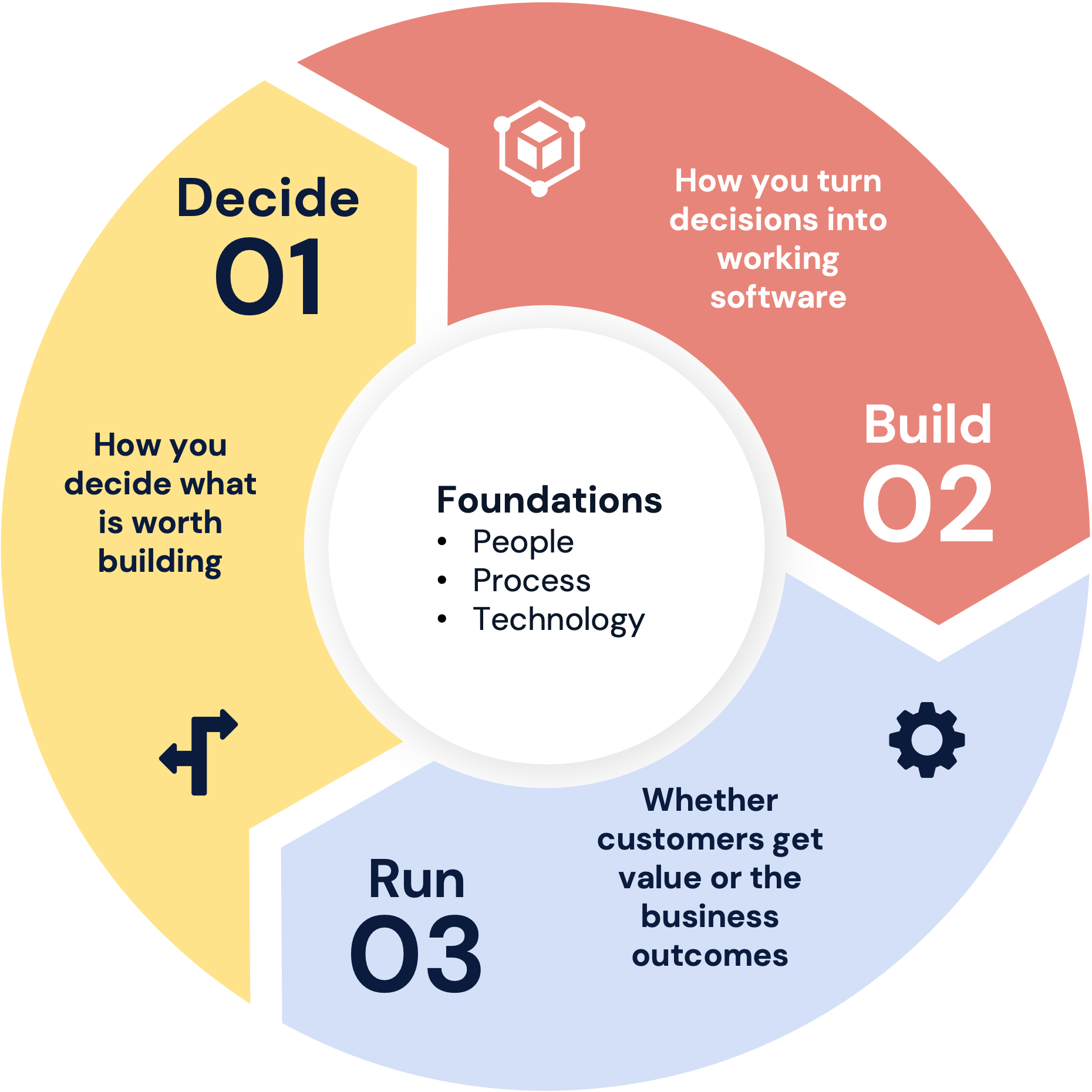
The gains from AI aren't in the tools. They're in the system around them.
The real gains come from redesigning workflows, ownership, verification and measurement, and they are captured at the seams between teams, not just inside them. That is why we look at the whole system before recommending anything.
We start with your ambition and the delivery system you actually have, not a tool. Then we build the roadmap that connects the two, one step at a time.

01
Agree what the business wants AI to achieve: growth, margin, customer outcomes or speed.

02
An objective view of how product and technology delivery performs today, AI adoption included.
03
Find where work slows down, where decisions are weak, and what AI would amplify rather than fix.

04
Prioritised AI value plays, each linked to a measurable business or customer outcome.

05
The skills, data, platforms, governance and roles that must be in place before you scale.

06
A roadmap of tactical, strategic and lighthouse moves, in the right order, with clear owners.

07
Data-driven from the start so you can track outcomes, impacts and ROI.
AI only pays off when it lands in a system ready for it. Our diagnostic, the Delivery 360, shows how your organisation really turns technology into results today, where AI will make the biggest difference, and what needs to change first.
We start with what you want AI to achieve, where leaders think the blockers are, and the questions that matter most. This decides what we measure and who we speak to.
We baseline your current delivery performance to see how you're performing now and to surface early signals of issues. This becomes the benchmark for measuring AI's impact.
We talk to people across the business, not just technology, and review your tools, processes and data. This shows where AI will amplify what works and where it will expose what doesn't.
We combine the data and the findings into one clear diagnostic and work with you to identify where AI will pay off, the constraints to fix first, and a prioritised roadmap to get there.
4 to 6 weeks from kick-off to roadmap.
Low on resource. High on impact.
Leadership, product and technology aligned on what's really happening and where you want to go, backed by evidence rather than opinion.
Benchmarked against comparable businesses, with the data to track the impact of every change, including AI.
See where the problems sit in your organisation now, and anticipate where they will land next. Stop fixing the wrong thing.
AI investment where it makes a real difference for your organisation: aimed at your issues and your constraints, not more tools and pilots that never add up.
Optimise the whole system to cut the delays and waste between deciding, building and launching, and surface technical risk before it becomes expensive.
Prioritised, sequenced actions: quick wins now, structural changes over time.
If you're under pressure to improve technology delivery and aren't sure where the real problem sits, a 30-minute call is usually enough to understand your specific situation and whether we can help.
