
AI is changing how software gets built. It's changing how fast code is written, who or what writes it and how quickly products change once they're live. It's changing everything, everywhere and all at once.
But it hasn't changed the fundamental goal of all of that activity: to get value to customers and achieve business outcomes.
Every organisation exists to create value for its customers and achieve its own business outcomes. For technology organisations this means delivering products and features. But success isn't just about the software. That's only one part of the journey.
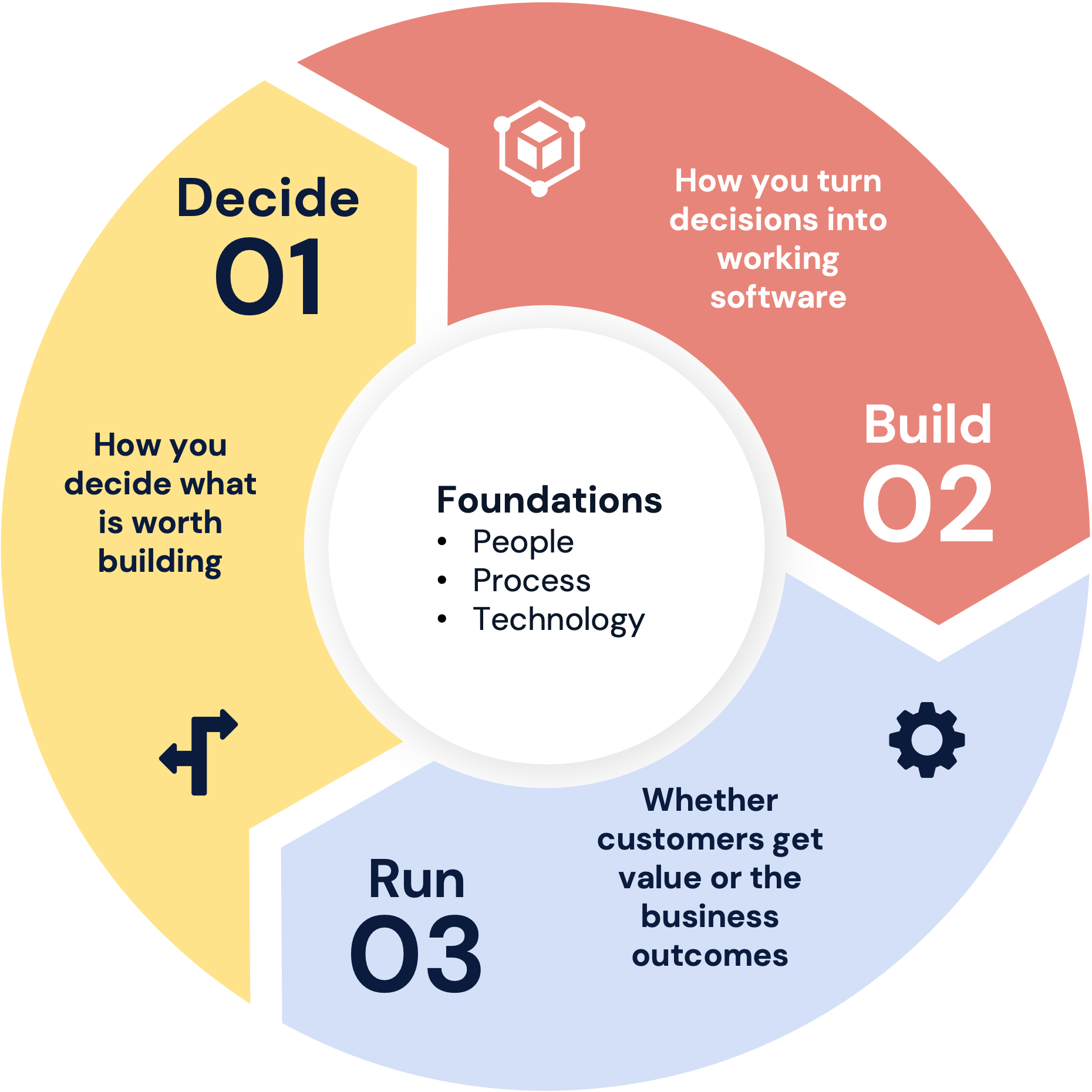
That journey has three moments. First you decide what is worth building (Decide). Then you turn that into working software (Build). Then customers use it and the business sees the result (Run). What you learn feeds the next decision. Technology delivery is one link in that chain. To understand and improve business outcomes, you have to look at the whole system. That is what the Delivery 360 does.
How well your organisation chooses what is worth building.
Are the decisions right, validated and not just made?
What happens here
Strategy, market and customer insight, positioning, discovery, design and experimentation, prioritisation and how demand gets in.
What it produces
A strategy that's actually used to decide. A roadmap people trust. Clear requirements Build and Run can work from.
How well you turn those decisions into working software.
Is the work flowing, fast, reliably and predictably?
What happens here
Engineering delivery, team design, platform and tooling, architecture and increasingly AI agents working alongside engineers.
What it produces
Working software. A codebase in a known condition, better or worse than it started. Releases in customers' hands.
How well customers realise value and the business sees outcomes.
Is it turning into value: adoption, outcomes, return?
What happens here
Launch, onboarding, support, security, measuring outcomes and the cost and return of the technology.
What it produces
A stable service. A measured result. A learning that changes the next decision.
All of these stages and the activities within them are underpinned by your capabilities:
Who is running it: leadership, autonomy and accountability, and key-person risk.
How work moves: coordination, collaboration and handoffs, and whether the operating model fits the work.
Whether you can measure what's happening and trust the numbers.
Does engineering receive a clear, validated problem, or a half-formed request?
Does what's built reach customers and is the business ready when it does?
Does what you learn in the market change what you choose next?
The Delivery 360 is a whole-system approach to one question: how well does your organisation turn technology investment into customer value, and will it keep doing so as things change? We look at your organisation through 30 dimensions and hundreds of data points to build the full picture. Here's everything we examine to answer it.
Decide How you choose what's worth building
Strategy and intent
Is there a strategy people actually use to decide?
Market context and adaptability
Do you see shifts coming, AI included, and can you respond?
Customer discovery and research
Are problems validated before you commit to building?
Commercial positioning and differentiation
Is your market position clear and backed by evidence?
Demand management and capacity allocation
How does work get in, and where does capacity really go?
Roadmap, prioritisation and plan credibility
Do people trust the plan, and does it survive new evidence?
Solution design and experimentation
Do you learn cheaply before committing expensively?
Product lifecycle
Do stop and retire decisions actually get taken?
Build How well you turn decisions into working software
Technology delivery operations
Speed, quality and reliability, measured and observed.
Team boundaries, dependencies and cognitive load
Do team boundaries follow the work?
Platform and developer experience
Does the platform speed engineers up or get in their way?
Architecture and technology health
What condition is the codebase in, and which way is it heading?
AI-assisted engineering
Code agents, testing agents, guardrails and context.
AI in the product Depending on the brief
What your product's AI can do, and what it's allowed to do on a customer's behalf.
Run Whether customers actually get the value
Go-to-market and launch
Is the business ready for what ships?
Customer onboarding and support
Do issues get resolved without draining engineering?
Outcome measurement
Did anyone check whether it worked?
Learnings and decision feedback
Did what you learned change the next decision, and fast enough?
Technology cost and economics
What each outcome costs to deliver and run, not just what the infrastructure costs.
Commercial performance and value capture Depending on the brief
Do you capture the value you create?
Security, privacy and compliance Depending on the brief
Is the speed you're gaining safe for your customers and your data?
Foundations Whether the organisation can run the chain, and trust what it's told
Technology and data
Measurement and data integrity
Can you measure what's happening, and trust the record?
Assurance and signal integrity
Does bad news reach the top, and would you notice if something live started to drift?
Product ops tooling
Does the tooling support the process, or does everyone work around it?
Process
Coordination mechanisms and ways of working
Do coordination routines create alignment without eating the capacity they're meant to protect?
Cross-functional collaboration and handoffs
Are handoffs clean?
Operating model and fitness
Are you good at the operating model you've chosen? We judge that against your model, not ours.
People
Leadership and ethos
Do problems surface early, and does failure produce learning?
Autonomy and accountability
Who can act without asking, and who answers when it goes wrong, whether that's a person or an AI agent?
Organisation and people risk Depending on the brief
What happens if key people leave?
Thirty dimensions isn't the point. Seeing how they connect is.
We bring two kinds of evidence together. Quantitative data shows how work actually moves through your organisation and what it produces. Qualitative research finds the reasons why. Together they give us a picture of what's going on in your organisation and what to do about it.
What your systems record.
From the tools you already use. We work with whatever you have. Or we can bring our own.
What your trackers, roadmaps and dashboards show, and what effect they have on value creation.
Where it's useful, an automated read of the codebase itself. It shows the risk being built into the code today, before it shows up as cost tomorrow.
What people know, and what the market is doing.
Across leadership, product, engineering, commercial and operations, because every function holds part of the answer.
A confidence read across the wider organisation. The gap between what leadership believes and what everyone else sees is often the most important finding.
Your market, your competitors and the technology shifts around you.
We test findings with your leadership and turn them into decisions, not just a report.
No single source decides a finding. Where the data, the people and the code agree, we're confident. When they disagree, that's usually the finding.
We read every part of the system against four measures. The fourth is the one most assessments leave out: whether the way you deliver value today is one you can sustain. But we're not only looking for what's at risk. We're looking for the improvements and optimisations that are realistic for your organisation: at your stage, with your people, budget and priorities.
How quickly a need becomes value in customers' hands.
Whether what reaches customers works, and keeps working.
Whether the product or feature delivers the value or outcome we intended.
Whether you can keep doing all of this as the market, the technology and your organisation change.
All of that evidence comes down to a short list of things worth doing, from strategic choices for the leadership team to changes a team can start next week. Every one is tied to the outcome you're trying to achieve and the return it should bring, so you know what to do first.
DISCOVERIES
The real constraint and its root cause, which is often not where anyone expected. A roadmap that changes faster than engineering can finish anything. Decisions that wait weeks before work starts. AI-written code queuing in review.
QUANTITATIVE INSIGHT
Speed, quality, flow, cost and decision latency, measured from your own data and set against your context, so you have a baseline to improve from.
QUALITATIVE INSIGHT
What people believe against what the data shows, where trust breaks down and the gap between leadership's view and everyone else's.
STRATEGIC MOVES
Where to invest, what to stop, how to shape the roadmap and operating model, or where AI will genuinely pay off.
TEAM-LEVEL ACTIONS
Practical changes to how work comes in, moves and gets released, sized so teams can act on them without waiting for a programme.
ORGANISATION AND STRUCTURE
Team boundaries, decision rights, and who owns each handover and the loop, so improvements stick once we step away.
If you're under pressure to improve technology delivery and aren't sure where the real problem sits, a 30-minute call is usually enough to understand your specific situation and whether we can help.
