
Whether something is going wrong or you want to go somewhere new, such as making AI pay off, Delivery 360 baselines how your organisation really works and shows you where to act. Four to six weeks, run remotely.
Introduction
Delivery 360 is an independent, evidence-based diagnostic of how your organisation turns technology investment into business outcomes. We start from a hypothesis: a challenge to meet or an opportunity to take. The result is a clear route to meeting the challenge or taking the opportunity.
Most engagements start from one of these.
What we have, and what we need to change
Delivery is slow, and hard to predict.
We're not delivering the features customers want.
Quality is slipping: bugs, outages and rework.
AI has been adopted, but the return isn't there.
We know the importance of AI, but we don't agree on priorities, or on what success looks like.
We've got new bottlenecks. AI just moves the delay into review, testing and decisions.
We have no clear baseline, so spend, AI included, can't be tied to outcomes.
What we could do with this moment
Increase velocity: deliver more of what matters, faster.
Raise organisational excellence: clearer ownership and better decisions.
Use AI across the whole delivery stream, not only in engineering, including agentic AI, and know whether you are ready for it.
Scale, or prepare for investment or due diligence.
A new direction, and what it would take to get there.
Migrate legacy code, or reimagine it.
Our view
Getting value from technology starts well before anyone writes code, and carries on after it ships. First, the organisation must decide what is worth doing (Decide). Then those decisions must be turned into working software and features (Build). Then the business launches it, people use it, and the value shows up, or doesn't (Run). Adoption and commercials close the loop and inform the next decision.
Each step has to work well for the next one to work at all, and the handovers between them are a key part of that. This needs a 360 view: an assessment of the whole value journey, from decision to result. We trace the value across leadership, product, engineering, and the operational teams. AI is part of that picture. It changes how the work gets done, not whether every step has to work.
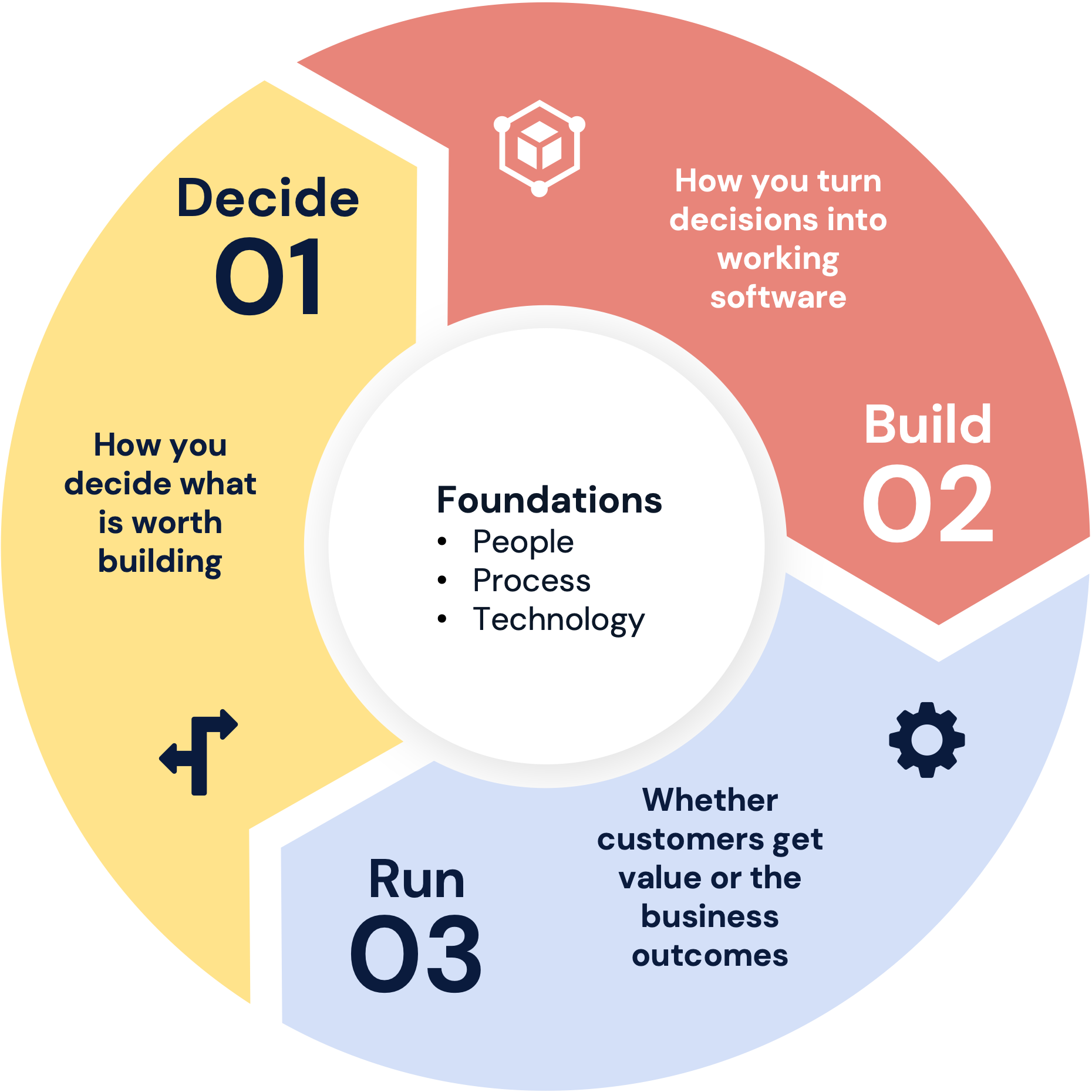
Decide
Build
Run
What we assess
Technology only pays back when the whole system works together: deciding what to build, building it well, and getting it into customers' hands. We don't mind whether you run Agile, waterfall or something of your own. The same goals still have to be met, and outcomes are what we judge.
How well your organisation chooses what is worth building.
Are the decisions right, validated and not just made?
What happens here
Strategy, market and customer insight, positioning, discovery, design and experimentation, prioritisation and how demand gets in.
What it produces
A strategy that's actually used to decide. A roadmap people trust. Clear requirements that carry intent and give Build and Run something to work from.
How well you turn those decisions into working software.
Is the work flowing, fast, reliably and predictably?
What happens here
Engineering delivery speed, quality and impact. Platform and tooling, architecture and, increasingly, AI agents working alongside engineers.
What it produces
Working software that carries outcome intent. A codebase in a viable condition. Releases that get value in customers' hands quickly.
How well customers realise value and the business sees outcomes.
Is it turning into value: adoption, outcomes and return?
What happens here
Launch, onboarding, support and maintenance, security, outcome measurement and the cost and return of the technology.
What it produces
Features adopted. Revenue and retention you can trace back to the work. A stable service. Learnings that inform the next decision.
How we ASSESS
For every item in every step, we ask the same three questions, in order. It keeps the assessment consistent, and it shows you where something is missing, weak or simply not trusted.
1. Is it there? Is there a clear way of deciding what to build next?
2. How well does it work? Does it produce good decisions quickly, with the risks understood? We look at who decides (people), how it runs (process) and the tools and data it relies on.
3. Is there confidence in it? Do teams across the organisation believe in the roadmap it produces?
THE PROCESS
We start from your hypothesis, so the work is scoped to what matters to you. Then we build the evidence in three layers, so the findings rest on facts rather than opinion: what the numbers show, what people tell us, and what it means for your outcomes.
Week 1
We start with the business context: what you are trying to achieve, where leaders believe the issues are and what questions the diagnostic must answer. That shapes what we measure, who we speak to and how we weight what we find.
Weeks 1–2 · Quantitative
We pull delivery data from the tools you already use, and bring in financial and operating data where it helps. We benchmark against comparable businesses, not abstract industry averages. This gives the first signals of issues and opportunities.
Weeks 2–4 · Qualitative
Structured conversations across the business, from leadership to product, engineering, commercial and operations, and short role-specific surveys for the wider team. Desk research on how work really flows runs alongside.
Weeks 4–6 · Outcomes
We combine the numbers, the conversations and the research into one view. Each finding comes with its cause, what it is worth, and a prioritised recommendation. We walk your leadership through it as a conversation, not a document hand-off.
Four to six weeks from kick-off to findings.
Run remotely and light on your team. All we need is a point person to coordinate access, plus read access to the tools you already use and time for a short round of interviews and a brief survey. No new platforms, and no disruption to delivery.
What you COME AWAY with
Above all, your leadership team is aligned on what you have, what is working, what is not, and where you can go.
Output 01
Where your time and money are going, where the risk and the opportunity sit, how fast you deliver, how good the quality is, and the impact against what you are trying to achieve.
Output 02
The issues, what causes each one, and what it would take to fix them.
Output 03
Where you could go: what to optimise, what legacy to unwind, and where AI can help.
Output 04
Each finding and opportunity ranked by impact and effort.
Output 05
A working session that gets your leaders on the same page.
Output 06
Recommendations agreed and sequenced into now, next and later, with owners.
If delivery is under pressure and you aren't sure where the real problem sits, a 30-minute call is usually enough to tell whether a Delivery 360 would help, and what it would look at in your situation.
